Justice Clarence Thomas Responds to Critics Who Question His Racial Identity Over His Political Views
Supreme Court Justice Clarence Thomas said critics have questioned his racial identity because of his political views, responding with the phrase "Look at me" while grabbing his arm. Thomas made the remarks in a conversation with Peter Robinson at the Hoover Institution, which included a discussion about the role of Black Americans in politics. He credited economist Thomas Sowell with helping him develop the confidence to articulate views that diverged from what he described as prevailing expectations for Black Americans.
Single source · Not corroborated
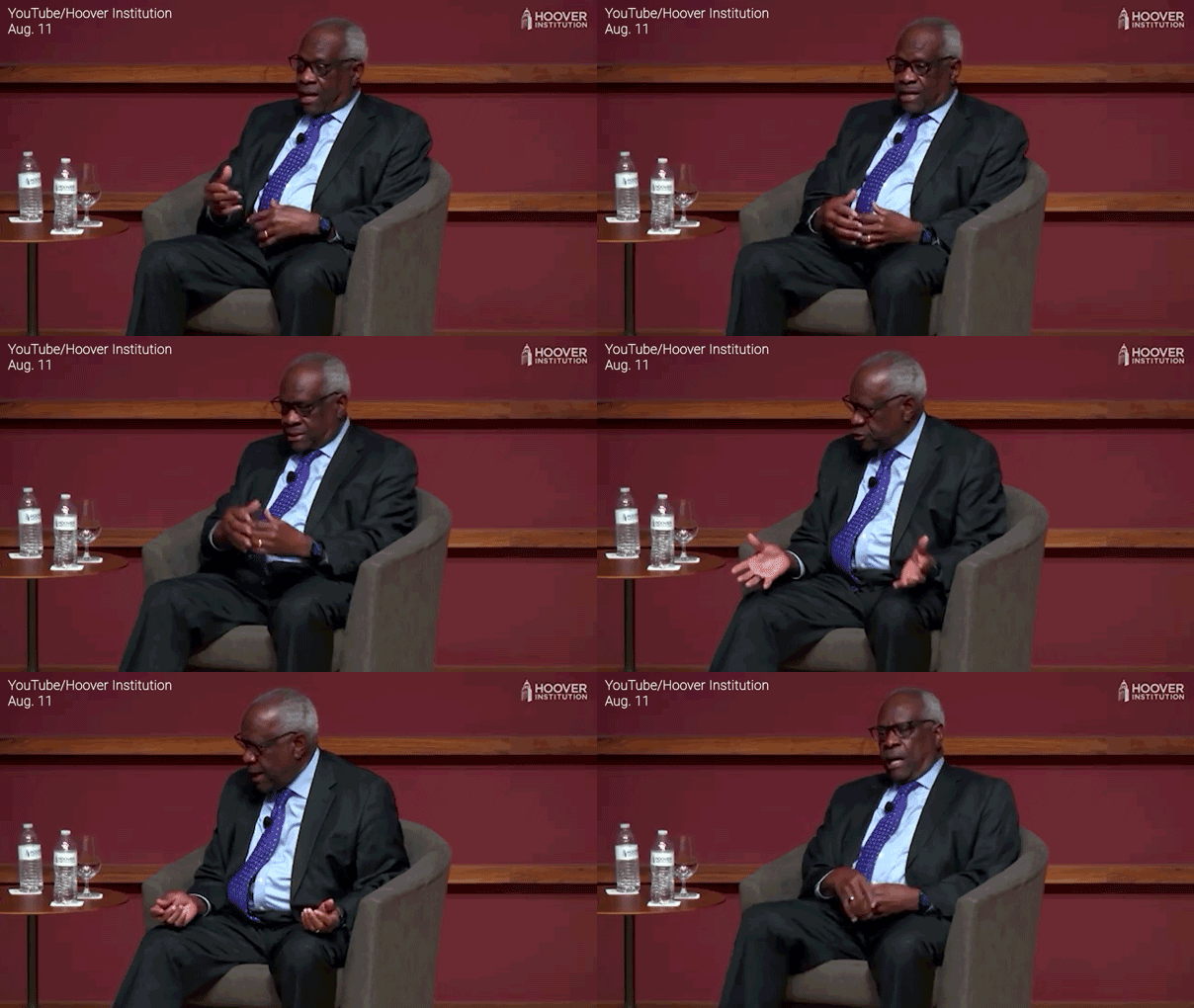
Justice Clarence Thomas addressed criticism of his racial identity during a Hoover Institution conversation with Peter Robinson, saying critics have used his conservative political views to question whether he is authentically Black. "If they can prove you wrong, fine," Thomas said. "But if they call you names or say you're not black, I mean, how stupid is that? Look at me." He made the remark while grabbing his arm.
Thomas described feeling pressure as a young man to adopt certain political beliefs because of his race, and said media figures, politicians, and prominent voices reinforced the message that deviating from those beliefs was wrong. "You have these views, you have these instincts, but you are getting inputs from the media, from the politicians, the people who have the megaphone, the people who have the loudest voices, that tells you you're wrong, that tells you you're bad," he said.
Thomas recalled voicing skepticism about school busing while at Yale Law School, questioning why Black families would want their children sent across town to unfamiliar schools and neighborhoods. He said the response he received was that he "shouldn't believe that" because he was Black. He also pointed to what he described as a disconnect between Black political leaders and ordinary Black Americans on issues like busing and racial preferences.